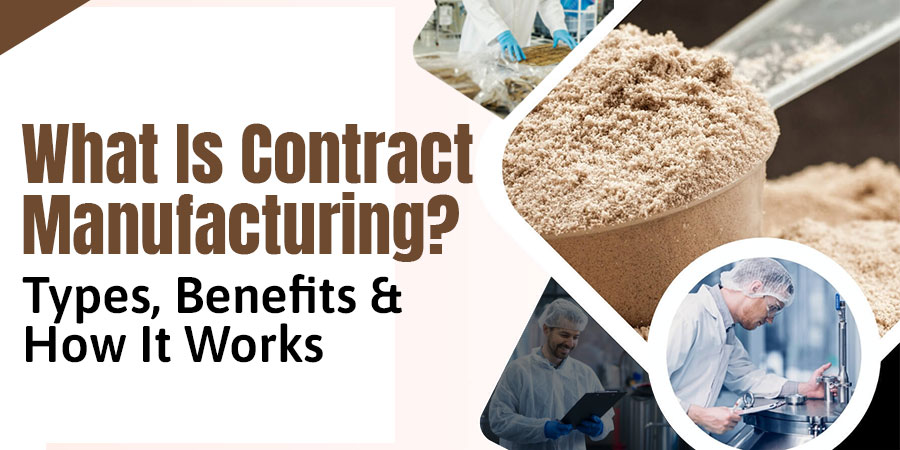
Want to know what contract manufacturing is? Recently, contract manufacturing has become a term that manufacturers use to bring to light certain aspects of production. In effect, this becomes one of the definitions of contract manufacturing as discussed in this introductory guide. In today’s fast-changing and competitive business environment, many companies are seeking cost-effective ways of producing goods without compromising quality. For this, the most well-known answer is contract manufacturing. In this business model, companies outsource production processes to third-party manufacturers and focus on their competencies such as marketing, design, or sales. This blog discusses what is contract manufacturing , its working mechanisms, types of it, top benefits, and what businesses should consider before choosing the model.
What is Contract Manufacturing?
A contract manufacturing model entails a business arrangement where an entity seeking to produce products in bulk outsources manufacturing to another company that specializes in this service. This model is adopted very much in industries such as pharmaceuticals, electronics, automotive, cosmetics, food & beverages, and dietary supplements.
How Does Contract Manufacturing Work?
Product Design & Specifications
The hiring company’s responsibility is to design the product and define technical specifications, ingredients, packaging, and quality standards.
Manufacturer Selection
Choosing a contract manufacturer based on capabilities, certifications, pricing, capacity, and reputation.
Signing Agreement
The contract includes clause elements about responsibilities, timelines, pricing, confidentiality, and intellectual property rights between the two parties.
Production Begins
The contract manufacturer begins the production process according to the terms and in compliance with quality and regulatory standards.
Quality Control and Delivery
Finished goods go through quality checks and are then packaged and delivered to the hiring company or directly to customers.
Types of Contract Manufacturing
Private Label Manufacturing
The buyer’s brand sells products manufactured by the manufacturer. This is commonly seen with cosmetics, foods, and supplements.
Original Equipment Manufacture (OEM)
Products are manufactured according to client designs by the contract manufacturer. Used mostly in electronics and automotive.
Component Manufacturing
One who has produced only specific components or parts of a product, and the hiring firm completes the assembly of the product.
End-to-End Manufacturing
Manufacturers handle the complete process from raw material sourcing through production to packaging and shipping.
Benefits of Contract Manufacturing
Fast Time-to-Market
Leveraging the manufacturer’s existing infrastructure speeds up production.
More Focus on Core Business
Companies can concentrate on R&D, marketing, and business growth while outsourcing production.
Scalability
Synchronizes easily up and down with market demand, while avoiding fixed costs.
Access to Expertise
Most often, contract manufacturers are specialized in the industry having advanced machines and compliance.
Reduced Risk
The production and labor risk associated with machine maintenance is absorbed by the manufacturer.
Potential Risks and Challenges
- The primary risk would be loss of control when it comes to production and quality.
- Intellectual Property (IP) Risks, especially if not legally protected.
- Gaps in Communications, which can happen often internationally.
Who Should Consider Contract Manufacturing?
Contract manufacturing can be best for:
- Startups or small businesses that lack production capacity.
- Brands are doing marketing but not manufacturing.
- Businesses are launching the new product without much capital commitment.
Tips for Choosing the Right Contract Manufacturer
- Certifications Must Be Verified – GMP, ISO, FDA depending on the industry.
- Assess Capabilities – Not all contract manufacturers may accept the complexity and volume of your product.
- Quality Control Check – Inquire about testing processes and criteria.
- Identify All Your IP – Have the NDAs signed along with mentioning IP protection clauses in contracts.
- Product Samples – Request Samples- Always check their product quality before committing.
- Client Reference Review – Know their reputation and existing clientele.
Regulatory Compliance
One of the most important matters concerning contract manufacturing is making sure that regulatory compliance is being implemented, and this is especially so in contract manufacturing relating to the pharmaceuticals, nutraceuticals, food, and cosmetic products. Manufacturers that are trusted usually follow Good Manufacturing Practices (GMP), ISO certifications, FDA guidelines (where relevant), and other country-specific regulations to ensure safety and quality. Companies, therefore, need to check for compliance with these standards by the selected manufacturer to avoid legal or reputational risks. These regulatory areas include labeling accuracy, ingredient sourcing, and hygiene regarding specific examples for businesses engaged in supplements or skincare.
Contract Manufacturing for Global Expansion
This increases the chances for the company to grow internationally by using contract manufacturing. Firms wishing to enter into markets outside their own can use contract manufacturing to partner with companies in those foreign markets to save on shipping costs, avoid import duties, and comply with local laws. This approach is most useful in fast-moving consumer goods (FMCG) because demand in this sector varies according to the region. The global contract manufacturing enables businesses to be agile and competitively placed in new markets without the entire investment upfront.
A Long-Term Growth Strategy
Contract manufacturing is not, for many brands, merely a short-term solution to cutting costs. Rather, it is a long-haul growth strategy: enabling the company to adjust to market trends more speedily, develop new concepts without heavy investments in infrastructure, and retain flexibility in the business model.
Final Thought
Contract manufacturing should change the lives of companies wanting to streamline their operations, cut costs, and scale their operations quickly. In partnership with the best manufacturer, companies will be able to create high-quality products in the market faster, thus concentrating on what they do best. The reality, though, is that it takes careful planning, clear contracts, and continued quality monitoring for a successful partnership. Whether you’re a startup with a great new product idea or an established brand searching to expand, contract manufacturing may be just what you need to grow strategically.