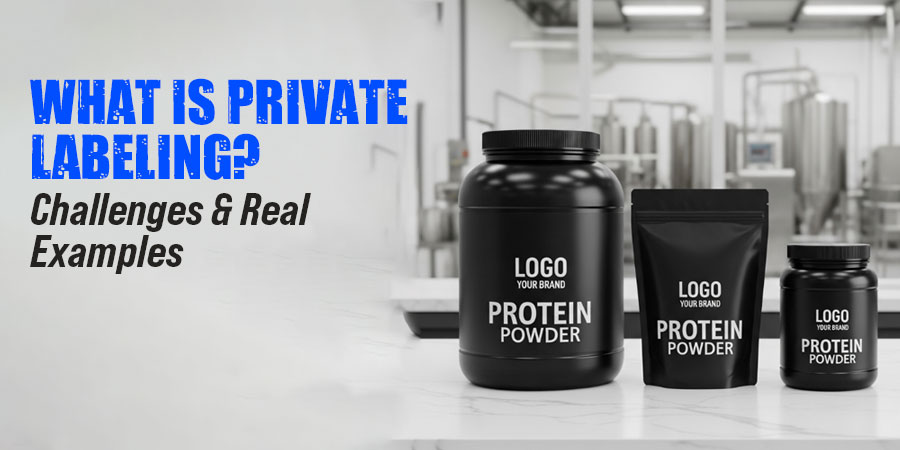
The current marketplace is highly competitive, and to develop a successful brand, you cannot rely on a good product; you need to have a sound strategy, distinctive branding, and well-executed operations. Private labeling provides one of the best means to achieve that without building the business from scratch. From global giants to budding entrepreneurs, private labeling has developed into a popular means of launching and scaling product lines. In this blog, we will find out more about what is Private Labeling, the benefits, challenges, and real-world examples of private labels, examining how brands have successfully leveraged it.
What is Private Labeling?
Private label is a commercial model by which a brand markets products manufactured by a third party. The products are usually manufactured in mass quantities by a supplier, and marketed with custom branding, packaging, and marketing by a retailer.
In layman’s terms, rather than investing in manufacturing, businesses outsource production and focus on building their brand identity and customer following.
- Health wellness supplements
- Skincare and beauty products
- Grocery and food items
- Fashion and apparel
- Household goods
What is Private Label Product?
Private label products are the goods that are manufactured by one company but it is sold under the another company’s name. However, this means a retailer contracts with a third-party manufacturer to produce products that are then sold under the retailer’s own brand. This allows retailers to provide products with their branding without needing to own or operate their own manufacturing.
How Private Labeling Works?
The private labeling process typically follows certain general steps:
- Find a Supplier: Partner with a manufacturer that offers white-labeling or private-labeling options.
- Product Customization: Work on packaging, branding, colors, and maybe even formulation.
- Branding: Design labels and logos and create marketing material that reflects brand values.
- Sales & Distribution: Sell the product on your e-commerce website, marketplaces with e-commerce functions like Amazon, or retail stores.
Benefits of Private Labeling
Brand Ownership and Control
As far as private labeling is concerned, you stand with an upper hand in every sense of the term: products, trademarks, branding, packaging, pricing, and marketing. Thus, they are free to carve a distinct identity for themselves in the market, thus engendering customer loyalty.
More Profitable Margins
Since there are branded private-label items, you are not just competing on price; therefore, you can afford to make a profit margin compared to anything generic or name-brand sold in stores.
Low Initial Capital Requirement
There is no need for large investments to set up production facilities or engage in heavy R&D, thus allowing one to launch their brand with close to nothing.
Time-Efficient
The manufacturers have the products prepared for production, thus allowing your brand to be launched in weeks rather than months, making it an ideal option for testing new ideas.
Product Customization Flexibility
It is more pleasant to work with private labels because you can design product specifications, packaging, and features to suit your market’s preferences.
Scalability
As your brand grows, you can very easily expand into different categories using the same business model and supplier relationships.
Disadvantages of Private Labeling
Despite this being an advantageous factor, private labeling has its fair share of challenges; familiarizing oneself with them would aid in making decisions wisely.
Minimum order quantities (MOQ)
The majority of factories will require some minimum amount of ordering, and this will require considerable liquidation of inventory if one requires immediate financial security. Hence, this may be a considerable hurdle for start-ups.
Quality Control Problems
Any deviation in quality, production delays, or inferior quality of the pack can severely dent your brand’s reputation due to your total dependence on the 3rd party suppliers.
Little Distinction
Your products could end up looking exactly alike in the eyes of buyers without unique formulations or features, especially if the supplier is providing multiple clients.
Manufacturer Dependence
Any disruption in the continuity of operation of the manufacturer, be it issues related to supply chains or changes in policies, will surely put your business in the firing line of discontinuity.
Brand Reputation Risk
Your brand could be negatively affected if the supplier engaged in unethical practices or delivered poor-quality products, which you could have been unaware of.
Private Labeling Versus White Labeling
Although often used interchangeably, a subtle difference exists.
- White Labeling: Products are sold to multiple retailers who rebrand them. All the products are generic.
- Private Labeling: Products are created exclusively for one retailer, giving them unique ownership over branding and design. Private labeling offers more exclusivity while being a somewhat faster and cheaper route; however, the least unique.
Some Real Cases of Private Labeling
Amazon Basics
Amazon can sell the items for less at the same level of quality, given that it takes advantage of the supply chain.
Kirkland Signature (Costco)
Kirkland Signature, Costco’s private label, applies to everything from snacks to household goods. Many of these products are made by popular brands, but they are sold only under the Kirkland name.
Trader Joe’s
About 80 percent of Trader Joe’s products are private-label products. Their model is based on proprietary, quality items that cannot be purchased elsewhere, engendering brand loyalty and exclusivity.
Target’s Up & Up
Target’s Up & Up sells inexpensive personal care and household products. This highlights the way retailers use private labeling to both enhance margins and retain customers.
Great Value (Walmart)
Great Value, Walmart’s private label, is widely considered one of the most successful private label brands; it offers an extensive range of cheap food and household items while making sure of quality to a standard.
Who Should Use Private Labeling?
Individuals or entities that should find private labeling appealing include:
- Entrepreneurs are launching a new product line.
- E-commerce sellers are looking to scale quickly.
- Influencers or public figures developing their brands
- Brick-and-mortar retailers expanding their offerings
- Startups with limited production capacity but strong branding skills
Wrapping It Up
Private labeling can pave your way toward branding, making entry into the market low-risk and high-return. The right product, good suppliers, and a strong branding strategy will get private-label companies great profit, much loyalty, and sustainable growth. But like other business models, private labeling has its challenges: it creates quality control problems, puts you at the mercy of your suppliers, and forces you into market competition. If all these are strategically handled, private labeling can turn a dull product into a massive success.