

In the fast-paced society of today, healthy and convenient-on-the-go snacks are extremely sought out by consumers. Granola bars promote nutrition and energy in just one mouthful. Whether you are an exercise buff, a busy worker, or just a health freak, granola bars are the best snack for you on the go. Now that you’re interested in starting your own health food business or are just curious about making granola bars from scratch (either at home or commercially), this guide will cover all about how to make granola bars, the basic ingredients, manufacture, and helpful tips for quality and consistency.
Granola Bars: What Are They?
Granola bars are snack bars composed mainly of rolled oats, honey, nuts, dried fruits, and sometimes chocolate or yogurt. They are usually compressed, then baked or chilled so that they become firm, portable bars. Their great nutritional value provides them with good fiber, healthy fat, and energy source. There are several granola bars uses through which you can achieve good health.
Granola Bar Manufacturing Process
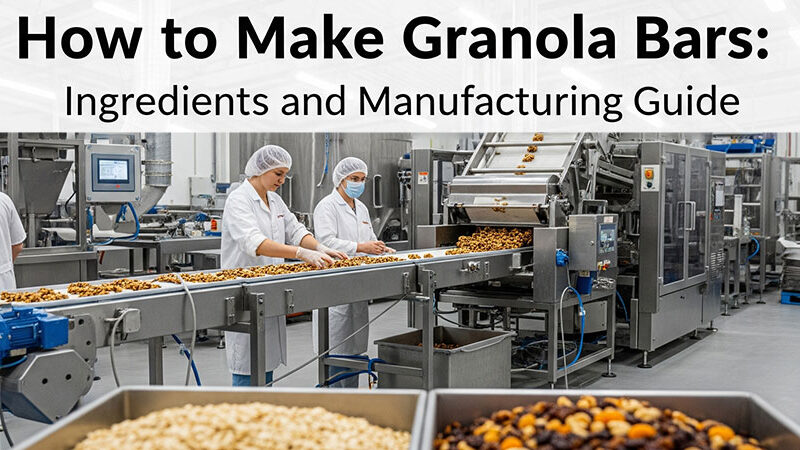
The process of manufacturing granola bars commercially involves a mix of art and science along with quality control.
Step 1: Ingredient Selection and Preparation
- All the ingredients are quality-checked and accurately measured.
- Nuts are roasted to increase the flavor.
- Dried fruits are chopped, if necessary.
- Oats are sifted free of impurities.
Step 2: Mixing and Blending
Dry ingredients are mixed in an industrial mixer. The binding syrup (preheated to a set temperature) is then added to mix evenly with the dry mix.
Step 3: Bar Formation
The extruder or sheeter flattens and shapes the granola mix into slabs of uniform thickness beyond which high-precision blades cut these into bars.
Step 4. Baking or Chilling
Baked granola bars are passed through a conveyor oven where they are lightly baked.
No-bake bars chilling in cooling tunnels simply set the shape.
Each method affects texture—baking results in a crunchier feel, while chilling gives a softer bite.
Step 5: Cooling and Packing
Once formed and set, bars are cooled to room temperature, packed using flow wrappers, sealed for freshness, and distributed to retailers. Packaging often includes:
- Nutritional labeling
- Expiry date
- Barcode scanning for retail
Step 6: Storage and Distribution
Bars are packed into cartons that are then put into temperature-controlled conditions before being distributed to retailers.
Main Granola Bars Ingredients
Now let us look in detail at very common and important ingredients used for the making of granola bars
1. Rolled Oats (The Base)
Rolled oats form the very backbone of a granola bar. Complex carbohydrates are provided that release energy at a slower pace and keep you full longer. Steel-cut oats or quick oats can also be used depending on preference of texture.
2. Binding Agents (Honey, Syrup, Nut Butter)
These agents are what hold everything together. The most common binders are:
- Honey
- Brown rice syrup
- Maple syrup
- Peanut or almond butter
Now, not only do they bind the mix together, but they also impart sweetness and flavor.
3. Sweeteners
Add sweeteners, often in small quantities, for additional flavor:
- Coconut sugar
- Brown sugar
- Agave nectar
- Date syrup
4. Nuts and Seeds
A good amount of nuts and seeds is used to give crunchiness and nutritional value:
- Almonds, cashews, walnuts
- Chia seeds, flaxseeds, sunflower seeds
5. Dried Fruits
Raisins, cranberries, apricots, dates, and figs bring natural sweetness, fiber, and chewy texture to the mix.
6. Flavor Enhancers
These include:
- Vanilla extract
- Cinnamon or nutmeg
- Cocoa powder or dark chocolate chips
7. Add-in (optional)
Whey protein, collagen, or probiotics could be added by a few brands to increase health benefits.
Quality Control in Granola Bar Production
To qualify for the standard being used internationally, manufacturing units must observe a very stringent quality protocol.
- Batch sampling for taste and texture
- Microbial testing
- Moisture content analysis
- Shelf life testing
- Packaging integrity checks
- Following FSSAI or FDA guidelines is crucial for regulatory compliance.
Equipment Required for Commercial Production
It is worth mentioning that if you are planning to produce granola bars commercially, here are some essential machines to have:
- Mixing tanks and ribbon blenders
- Syrup cookers
- Sheeters and rollers
- Cooling tunnels or refrigerators
- Granola bar cutters
- Flow wrap machines
Automation indeed accounts for more speed and consistency of production, especially when scaling up.
Best Tips for Making the Perfect Granola Bar
Below are some industry secrets and best practices for ensuring your granola bars come out perfect every time:
Maintaining that ratio of dry and wet liquid will cause the bars to be sticky and too little will allow them to crumble apart.
- Add protein or fiber: Enhances satiety and attracts health-conscious consumers.
- Keep sweets in check: Many go over sweetness; natural sweeteners fit the bill better with the health aspect.
- Never forget rest time: The mixture should sit after forming to allow it to bind better.
- Experiment with flavors: Try combinations like mocha-almond, cranberry-orange, or coconut-lime to twist things up a bit.
Trends in the Granola Bar Craze
The demand for snacks that are healthy, light, and convenient is skyrocketing. The granola bar market is on fire.
- High-protein granola bars
- Plant-based and vegan options
- Keto and low-carb varieties
- Gluten-free and allergen-friendly recipes
Sustainable Packaging:
- According to the report by Mordor Intelligence, the global snack bar market will grow at a CAGR of over 6.8% during the period 2024-2029.
- In a crowded granola-bar market:
- Go for clean-label ingredients.
Emphasize Unusual Selling Points:
- “High Fiber”, “No Added Sugar”, or “Handcrafted.”
- Consider putting QR codes that trace your brand’s story or the sourcing of your ingredients.
- Environmentally safe packaging attracts conscious consumers.
- Social media is critical for brand positioning and should consider influencers and recipe reels.
Conclusion
Granola bars are deliciously enmeshed in various strands of nutrition, flavor, and convenience. Whether we are in the kitchen making these bars for snacking or building our commercial line, a good knowledge base on raw materials and processes, alongside an understanding of market dynamics, places us at an advantageous point. Brands combining good ingredients and great flavors with smart features will give their granola bars a foothold in the highly competitive health snack segment.